 An official website of the United States Government
Official websites use .gov
A .gov website belongs to an official government organization in the United States.

A .gov website belongs to an official government organization in the United States.

A lock or https:// means you’ve safely connected to the .gov website. Share sensitive information only on official, secure websites
 |
Guidance on determining event types and associated risks
 Public
Release of a toxic chemical in a public area resulting in exposure, injuries, or deaths
Be aware of potential secondary releases/exposures
Unexposed bystanders may experience emotional shock and require mental health support. Potential for many casualties with physical injuries from crowd movement (trampling)
 Transport
Release of a toxic chemical due to a collision, derailment, or other transportation accident
Scene safety may need to be reassessed regularly due to risks of continued leaks, fires, explosions, or vapor hazards
Incidents involving railcars, ships, and sometimes trucks may involve more than one chemical. Potential chemical reactions may result in additional hazards
 Industrial
Release of a toxic chemical at a manufacturing, processing, or storage facility
Be aware of the potential for secondary risks such as fires or explosions due to presence of pressurized containers, volatile substances, or confined settings
Incidents occurring at industrial facilities may involve more than one chemical. Potential chemical reactions may result in additional hazards
 Intentional
Deliberate chemical release done with the intention to cause fear, mass harm, injury, or death
Be wary of the potential for secondary devices or ongoing threats
Preservation of evidence may be especially important for law enforcement investigation
Level of Chemical Incidents can be determined based on the event cues present on the scene. These can be categorized as:
 HAZMAT
The imminent or actual release of a toxic chemical into the environment at levels that require urgent response to contain the release and protect humans and the environment.
Any ONE cue rated “HIGH” or Any TWO cues rated “MODERATE”
 MEI
A chemical HAZMAT incident that produces multiple exposed victims. The event will be similar to, but more complex than, a Mass Casualty Incident as victims may be contaminated and represent a hazard to responders and others.
Is a Chemical HAZMAT Incident and Any ONE cue rated “HIGH”
 WMD
A chemical MEI resulting from the deliberate release of chemicals intended to cause widespread harm. A chemical WMD incident may involve the release of a toxic industrial chemical or a chemical warfare agent.
Is a Chemical HAZMAT or Chemical MEI and Any TWO cues rated “MODERATE”
Note: Some of the more subtle or rare cues that may indicate a chemical release has occurred can also have other explanations. For example, a recent drought could explain dead vegetation and lack of wildlife in the area. Stormy weather can cause low-lying clouds or puddles. Nearby manufacturing plants or agricultural facilities can contribute to local odors that can resemble chemical releases.
These cues should be considered in the context of the entire scene and local situation to determine whether a chemical release has occurred.
Confidence in recognition is high when you detect:
Any ONE of the cues rated “HIGH”
Any TWO of the cues rated “MODERATE”
| Event-Related Cues | Confidence |
|---|---|
| Observation of a chemical release | High |
| HAZMAT labeled container (e.g., placard or chemical name) nearby with damage or breach | High |
| Chemical-related container (e.g., storage tank, tanker truck, rail tank car) nearby with damage or breach | High |
| An unexplained plume or cloud (e.g., not from a fire) | High |
| Colored cloud or plume (e.g., green, yellow) | High |
| Unexplained odors (e.g., bleach, ammonia, bitter almonds) | High |
| Chemical-related facility (e.g., production, processing, storage, use, waste treatment, disposal) or container (e.g., storage tank, tanker truck, rail tank car) nearby | Moderate |
| Environment-Related Cues | Confidence |
|---|---|
| Low-lying clouds or fog not explained by the weather | High |
| Unusual number of dead or injured animals in the area | High |
| Dead fish, aquatic birds, and/or insects in and around water sources | High |
| Unexplained liquid puddle or powder deposit | Moderate |
| Oily sheens, coatings, or droplets on surface | Moderate |
| Clouds of dust or particles not explained by the weather or incident (e.g., building collapse) | Moderate |
| Unusual and unexplained dead, discolored, or withered plant life in area | Moderate |
| Victim-Related Cues | Confidence |
|---|---|
| Casualties with no apparent reason or trauma | High |
| Casualties clustered in a geographic area, especially downwind from incident scene or in low-lying areas | High |
| Same medical symptoms in multiple victims not explained by the incident | High |
| Breathing difficulty, coughing not otherwise explained (e.g., building collapse) | High |
| Burns or irritation on skin (not from fire) | High |
| Tearing of eyes not otherwise explained | Moderate |
| Disorientation not otherwise explained | Moderate |
Confidence in recognition is high when you detect:
Any ONE of the cues rated “HIGH”
| Event-Related Cues | Confidence |
|---|---|
| More than 10* victims observed that are “down” or require urgent and medical treatment. | High |
| Potential that more than 10* persons have been contaminated by or are in the Isolation Zone for the Chemical HAZMAT Incident | High |
| Any incident that could cause multiple casualties combined with potential exposures or contamination (e.g., major transportation accident, building collapse) at a location where 10 or more* persons could be affected | High |
*Use local definition of number of patients for MEI if known.
Confidence in recognition is high when you detect:
Any TWO of the cues rated “MODERATE”
| Event-Related Cues | Confidence |
|---|---|
| Credible threat of a terrorist attack applicable to the area | Moderate |
| Bomb or munition-like debris | Moderate |
| Debris that could have been caused by an explosion | Moderate |
| Unexplained persons wearing personal protective equipment (PPE) | Moderate |
| Unexplained discarded PPE | Moderate |
| Explosion with little or no structural damage | Moderate |
| Device that may have dispersed a mist or vapor | Moderate |
| Oily sheens, coatings or droplets on surface | Moderate |
| Unusual or unauthorized spraying in the area | Moderate |
| Suspicious persons urgently leaving the area | Moderate |
| Event-Related Cues | Confidence |
|---|---|
| Multiple casualties exhibiting similar symptoms | Moderate |
| Mass casualties with no apparent reason or trauma | Moderate |
| Sudden unexplained weakness, collapse, apnea, or convulsions | Moderate |
| Dimmed or blurred vision | Moderate |
| Hypersecretion signs and symptoms (such as drooling, tearing, and diarrhea) | Moderate |
| Inhalation signs and symptoms (eye, nose, throat, chest irritation; shortness of breath) | Moderate |
| Burn-like skin signs and symptoms (redness, blistering, itching, sloughing) | Moderate |
Explore other resources for First Responders such as arrival on scene, patient triage, patient assessment, and more.
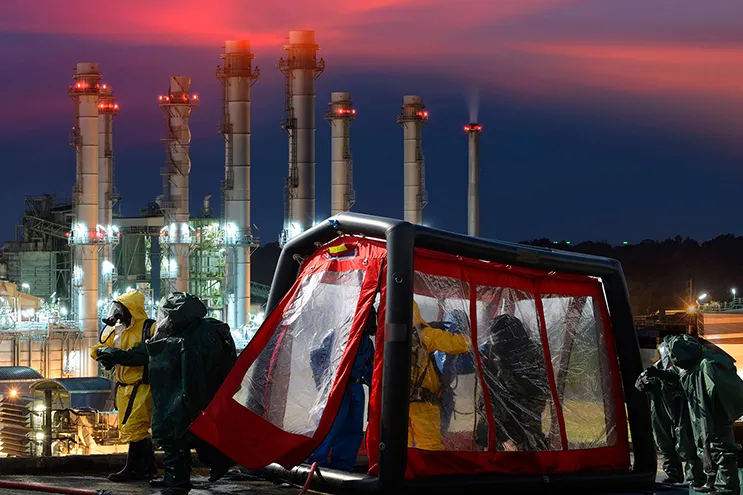
Additional information to help with chemical incident preparedness and response, including responder safety, hazard assessment, patient decontamination, triage, and more

Guidance for acute medical management of patients exposed to specific chemicals