 An official website of the United States Government
Official websites use .gov
A .gov website belongs to an official government organization in the United States.

A .gov website belongs to an official government organization in the United States.

A lock or https:// means you’ve safely connected to the .gov website. Share sensitive information only on official, secure websites
 |
The SALT triage algorithm assigns adults or children to five triage categories using clinical parameters that assess mobility, immediate life threats, spontaneous breathing, signs of respiratory distress, adequacy of perfusion, and mental status.
SALT was developed during 2008 as a national all-hazards mass casualty initial triage standard for all patients. SALT meets CDC’s “Model Uniform Core Criteria” for triage management of all casualties of all ages. The “Life-saving Interventions” guidance enables providers to treat immediate life-threatening issues while assessing the patient such as administration of antidotes for chemical incidents.
Select a view
a Life Saving Interventions
Control major hemorrhage
Open airway
(If child, 2 rescue breaths)
Chest Decompressions
Administer Antidotes
b Assess Physical and Mental Status
c Treat & Transport
DEAD
b Assess Physical and Mental Status
b Assess Physical and Mental Status
b Assess Physical and Mental Status
b Assess Physical and Mental Status
b Assess Physical and Mental Status
b Assess Physical and Mental Status
c Treat & Transport
MINIMAL
c Treat & Transport
DELAYED
c Treat & Transport
IMMEDIATE
c Treat & Transport
EXPECTANT
a Life Saving Interventions
Control major hemorrhage
Open airway
(If child, 2 rescue breaths)
Chest Decompressions
Administer Antidotes
b Assess Physical and Mental Status
SALT is endorsed by:
American College of Emergency Physicians (Home Page | ACEP)
American College of Surgeons Committee on Trauma (Committee on Trauma | ACS)
American Trauma Society (American Trauma Society)
National Association of EMS Physicians (Home - NAEMSP)
National Disaster Life Support Education Consortium (NDLSEC — National Disaster Life Support Foundation (NDLSF))
State and Territorial Injury Prevention Directors Association (Safe States Alliance)
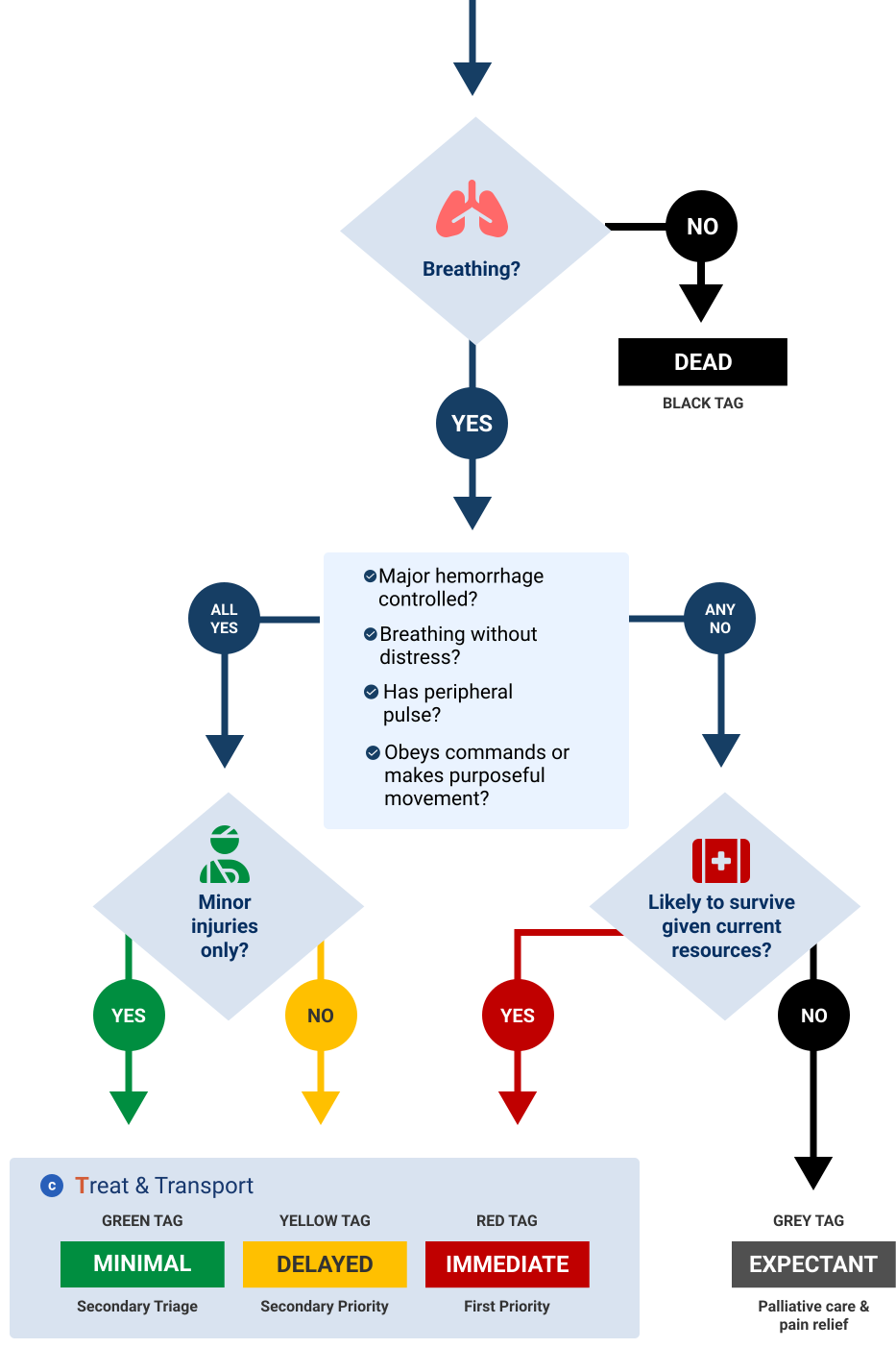
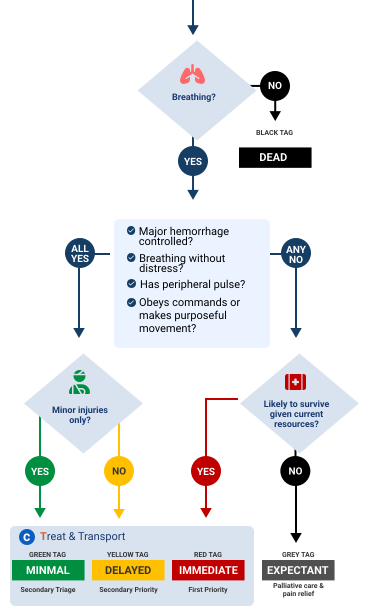
The graphic depicts a flowchart for the SALT (Sort, Assess, Life-saving Interventions, Treatment/Transport) triage system, which sorts patients into one of four triage categories, each of which has a distinct name and triage tag color:
Immediate, Red Tag: Patient has severe or life-threatening injuries but a high potential for survival; immediate treatment/transportation is required.
Delayed, Yellow Tag: Patient has substantial injuries and can follow commands but does not require immediate treatment/transportation.
Minimal, Green Tag: Patient has minor injuries only, can follow commands, and is otherwise stable. Patient may be able to assist in their own care and can wait for treatment/transportation until more serious patients are handled.
Expectant, Grey Tag: Patient is not expected to survive given the nature/severity of injuries, level/amount of care available, or both. Palliative care may be provided given sufficient resources.
Dead, Black Tag: Patient who is not breathing or who has injuries incompatible with life.
Triage is performed in two steps. Patients are first sorted globally by their visible physical condition. Patients who are not moving or have an obvious life threat should be assessed first. Patients who are able to wave or make purposeful movements should be assessed second. Patients who are able to walk should be directed to a safe area and assessed last. Individual patient assessments should take less than one minute and should focus on identifying and treating life threats by opening the patient’s airway (for children, two rescue breaths may be given), controlling major hemorrhage with a tourniquet, providing needle decompression of the chest (if so trained), or administering an antidote, if available. After providing lifesaving interventions, patients should be assessed for:
Mental status, as assessed by ability to obey commands
Spontaneous breathing
A palpable peripheral pulse
Respiratory distress
Uncontrolled hemorrhage