 An official website of the United States Government
Official websites use .gov
A .gov website belongs to an official government organization in the United States.

A .gov website belongs to an official government organization in the United States.

A lock or https:// means you’ve safely connected to the .gov website. Share sensitive information only on official, secure websites
 |
The JumpSTART algorithm assigns patients who appear to be younger than 8 years old to four triage categories using clinical parameters that assess mobility, spontaneous breathing, signs of respiratory distress, adequacy of perfusion, and mental status. JumpSTART is a modification of START that applies age-appropriate physiological parameters to assessing the status of pediatric patients.
JumpSTART was developed as a pediatric version of START in 1995 by the Miami, Florida Children's Hospital. It has since been updated in 2001.
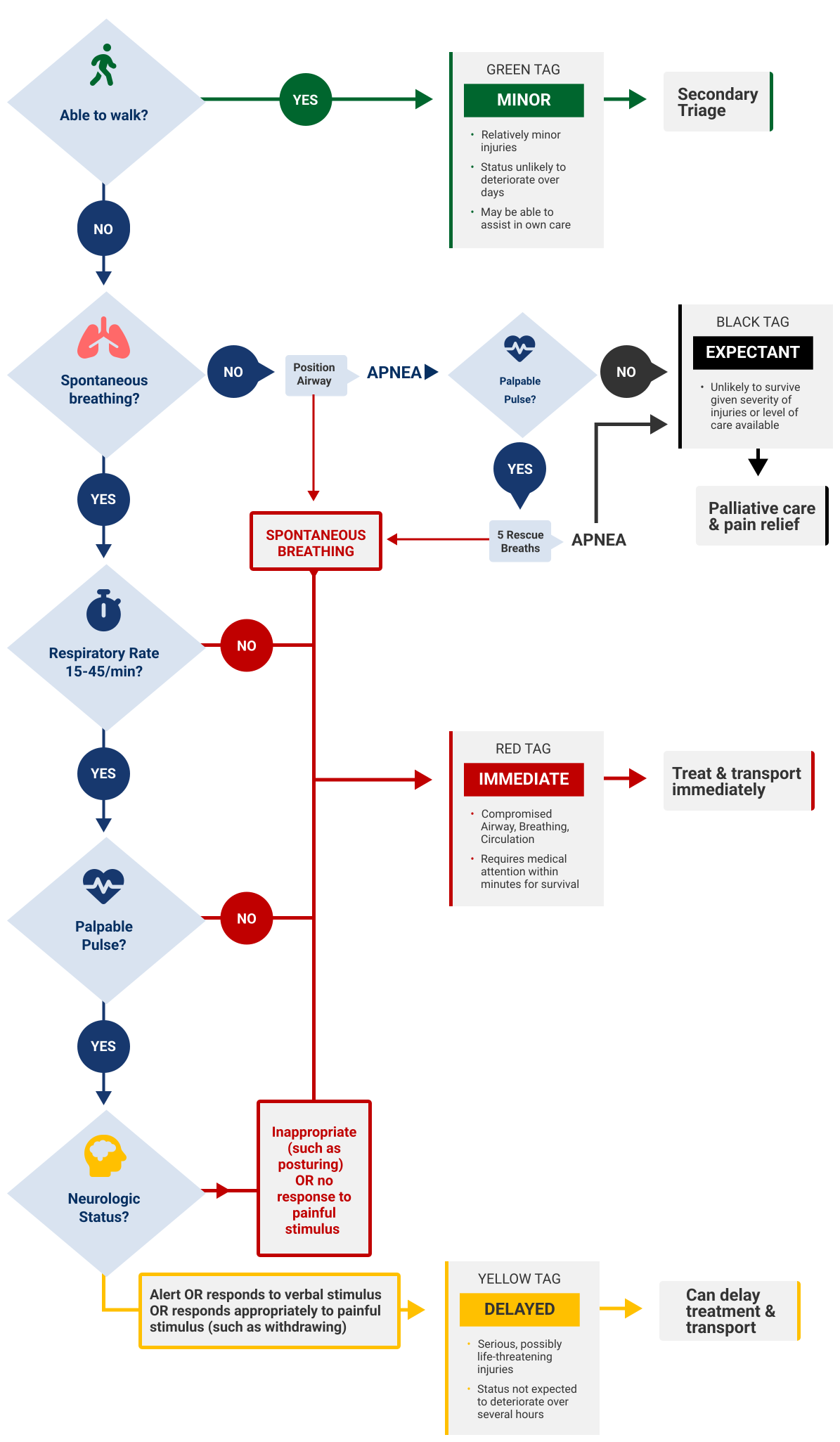

The graphic illustrates the JumpSTART mass casualty triage algorithm for children. The algorithm has four distinct clinical triage categories. Each category has been assigned a distinct name and triage tag color.
The four distinct clinical triage categories for mass casualty patients, with each category assigned a distinct name and color.
The 4 Triage Categories are:
Minor, Green Triage Tag Color: Patient has relatively minor injuries and their status is unlikely to deteriorate over days. Patient may be able to assist in their own care until secondary triage and treatment can be completed.
Delayed, Yellow Triage Tag Color: Patient has serious and possibly life-threatening injuries but status is not expected to deteriorate over several hours, so transport can be delayed.
Immediate, Red Triage Tag Color: Patient has severe or immediately life-threatening concerns that compromise airway, breathing, or circulation and requires immediate treatment and transport for survival. Condition expected to deteriorate within minutes.
Expectant, Black Triage Tag Color: Patient who is breathing but is unlikely to survive given the severity of injuries, level of care available, or both. Palliative care and pain relief should be provided.
Emergency first clinical responders would follow the clinical algorithm to evaluate each patient and assign a triage category and color based on various clinical parameters. The information would be noted on the triage tag attached to the mass casualty victim.
Rescuers following behind the triage officer would view the color and text of the triage tag and take appropriate action.
Clinical parameters used to evaluate patients include:
Ability to walk
Presence or absence of spontaneous breathing
Respiratory rate inside or outside the expected range of 15-45 breaths per minute,
Perfusion assessment by presence or absence of a palpable pulse, and
Mental status as assessed by alertness or appropriate response to verbal or painful stimuli