 An official website of the United States Government
Official websites use .gov
A .gov website belongs to an official government organization in the United States.

A .gov website belongs to an official government organization in the United States.

A lock or https:// means you’ve safely connected to the .gov website. Share sensitive information only on official, secure websites
 |
Decontamination is the process of removing or neutralizing a chemical that is on a patient's body or clothing to stop the exposure and prevent further harm. For most toxic chemicals, decontamination is a first line treatment that should be performed as soon as possible since removing or neutralizing chemicals on the patient's body or clothing reduces the time they are exposed to the chemical. Decontamination will typically reduce the overall severity of symptoms the patient will experience.
Decontaminating patients as soon as possible increases survivability and potentially decreases adverse heath effects of contaminants.
Be aware of secondary contamination impacts. Contact with contaminated patients could expose others if not properly decontaminated.
Select the preferred patient decontamination guidance
 PRISM GUIDANCE
The Primary Response Incident Scene Management (PRISM) guidance, first published in 2015 and
updated in 2018, was written to provide authoritative, evidence-based guidance on mass patient
disrobe and decontamination during a chemical incident.
Remove up to 99.9% of contaminant by following the Triple Protocol
View PRISM Guidance (HHS/BARDA, 2018)
Flowchart to identify the most appropriate form of emergency decontamination. Dry decontamination methods should be the default option unless contaminate is a particulate (e.g. powder) and/or caustic.
Be prepared: Requires at least 4+ or more absorbent materials (pads, dressings, towels, etc.) per patient
Dry Emergency patient decontamination options
Examples include:
Wet Emergency Patient Decontamination
Flowchart provides guidance for determining if gross decon may or may not be needed. Include professional judgment and scene-specific indicators to inform decision, as well.
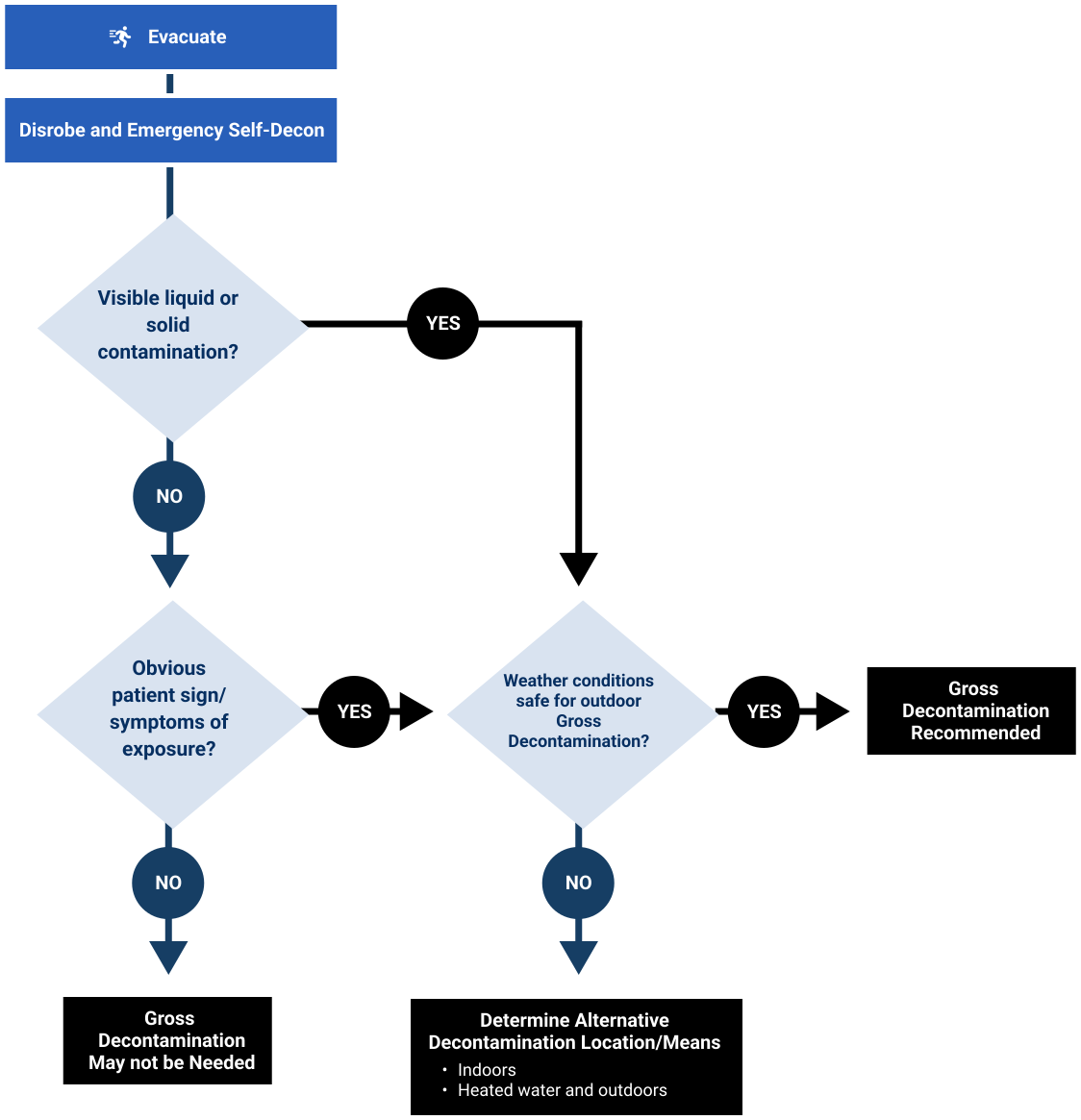
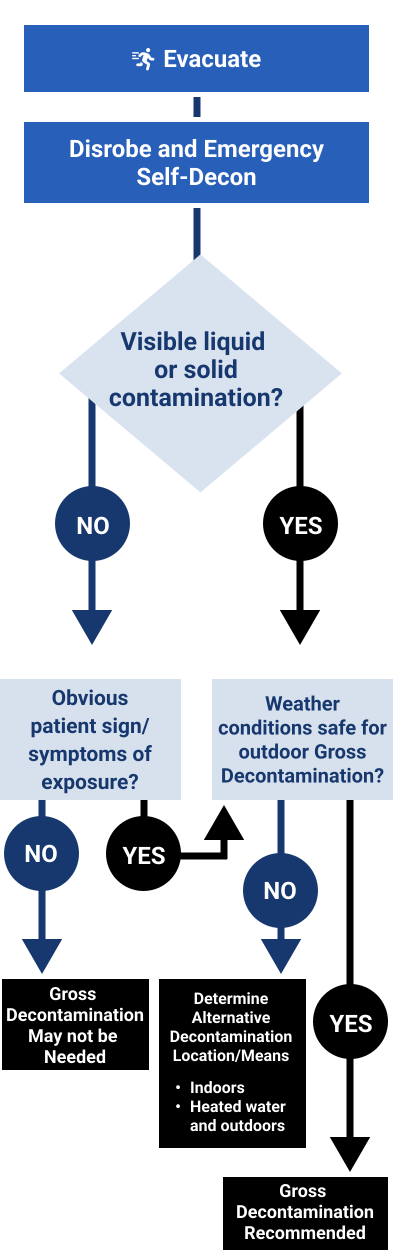
If you'd like more information about determining the need for gross decontamination see the ASPIRE tool
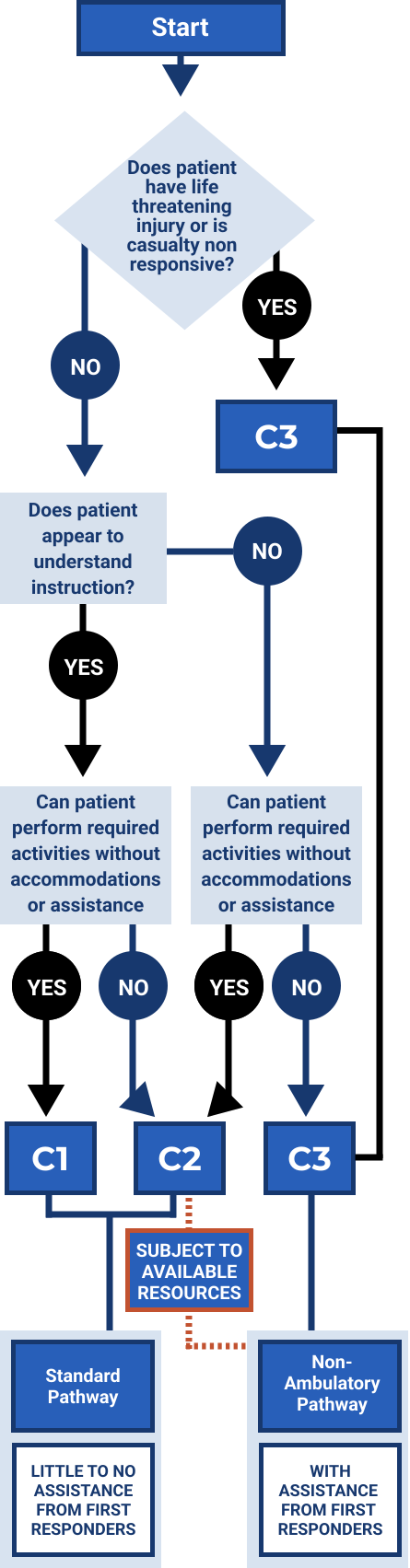
| Category | Definition | Decontamination Pathway |
|---|---|---|
|
C1
Ambulatory |
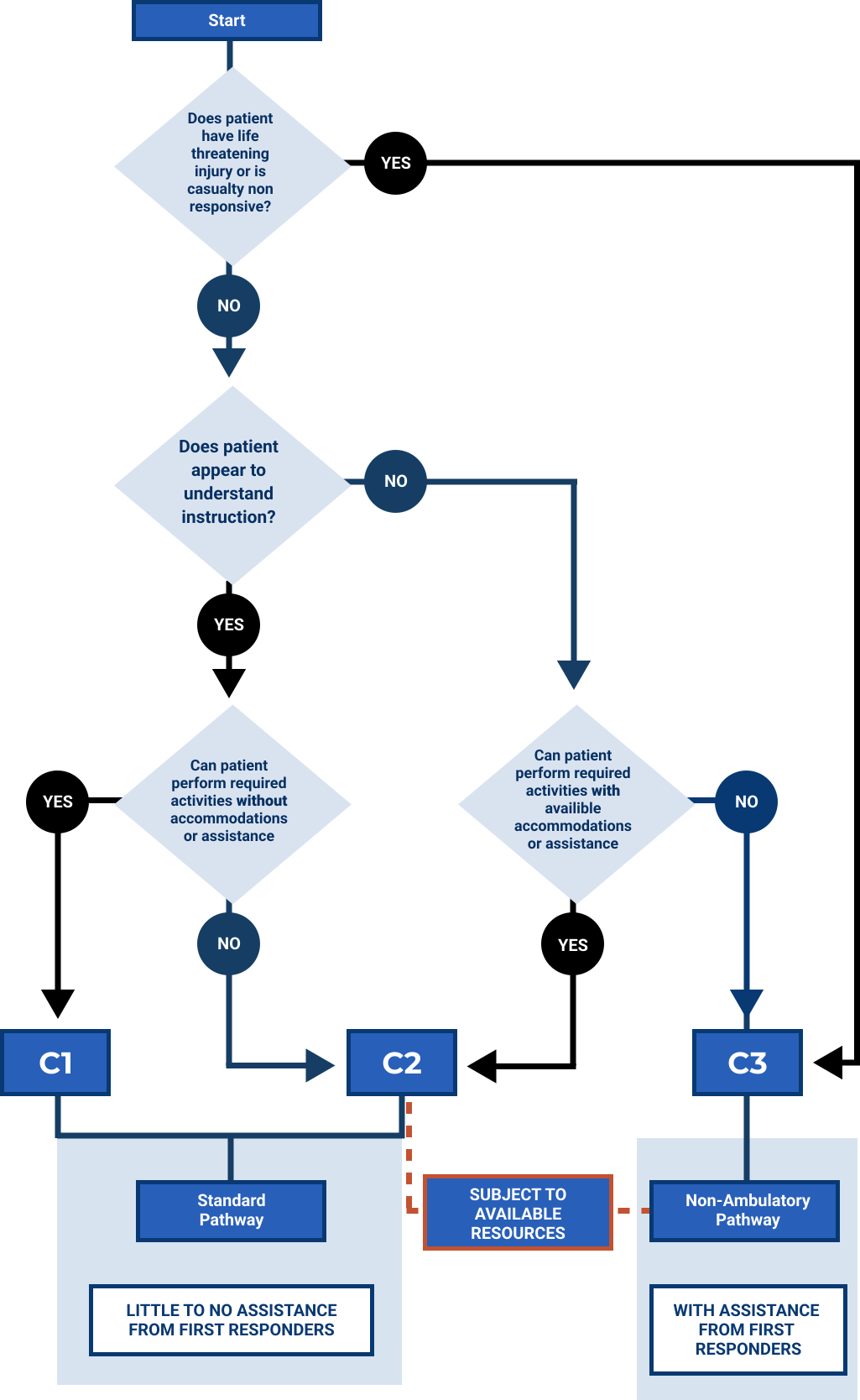
Patients who are able to understand instructions and perform activities without assistance | C1 - Standard |
|
C2
Communications challenged |
Patients who are either unable to understand instructions or unable to perform actives without accommodations or assistance | C2 - Standard or Non-ambulatory |
|
C3
Non-ambulatory |
Patients who are unresponsive, have life-threatening injuries or require extensive accommodations or assistance | C3 - Non-ambulatory |
Patients who are able to understand instructions and perform activities without assistance
C1 - Standard
Patients who are either unable to understand instructions or unable to perform actives without accommodations or assistance
C2 - Standard or Non-ambulatory
Patients who are unresponsive, have life-threatening injuries or require extensive accommodations or assistance
C3 - Non-ambulatory
Ambulatory patients process through all tiers of the decontamination process through Standard (Ambulatory) Response Pathway with or without assistance from first responders
Communications challenged patients process through either the Standard Response Pathway or Non-ambulatory Response Pathway depending on
Non-ambulatory patients process through all tiers of the decontamination process through a Non-ambulatory Response Pathway with a greater degree first responder intervention
All patient decontamination begins with evacuation of patients away and upwind from the hazardous area to a safer location for decontamination.
Evacuation is followed by disrobing. No form of decontamination should be undertaken before disrobing.
The “Triple Protocol” of sequentially conducting each tier as one continuous process provides the most benefit to the patients. Select patient decontamination tier based on available resources, personnel, and time required to set up more advanced tiers.
Do not delay patient decontamination to wait for set up of more advanced tier.
For all patient decontamination tiers, consider patient privacy and modesty. Provide a means to minimize viewing by non-essential personnel. Separate males and females, if possible, during decontamination processes, but keep families together.
Actions patients can perform for themselves:
See Determining the Need for Gross (wet) Decontamination and apply professional judgment in deciding if these steps are necessary
Ladder Pipe System (LPS)
Active Drying:
Current Environmental Protection Agency (EPA) guidance suggests decontamination performed for lifesaving operations takes precedence over containment or on-site treatment of water run-off.
Note: the synergistic clinical benefits of the Triple Protocol are best accomplished when all three stages are performed as one continuous process
Determining the Need for Gross (Wet) Decontamination also applies to the Technical Decontamination stage
Note: the synergistic clinical benefits of the Triple Protocol are best accomplished when all three stages are performed as one continuous process
The Patient Decontamination National Planning Guidance, published in 2014, provides principles set forth from a strategic perspective to guide, but not specify operational practices. The guidance is evidence-based to the extent possible and provides sources when possible.
View Patient Decontamination in a Mass Chemical Exposure Incident: National Planning Guidance for Communities (DHS/HHS, 2014)
Note: The Department of Homeland Security (DHS) has archived this content as it may contain outdated information that may not reflect current policy or programs.
If the answer to one or more of the questions below is "yes", patient decontamination is recommended:
Prioritize patients by estimating relative risk and grouping patients into urgent and non-urgent groups. For mass decontamination, do the greatest good for the greatest number of patients.
Considerations:
Select patient decontamination methods based on available resources, weather conditions, and type of containment
Dry patient decontamination options
Examples include:
Follow dry particulate material decontamination with wet method to remove particulate material
Examples include:
Select patient decontamination tier based on available resources, personnel, and time required to set up more advanced tiers.
The tiers are not necessarily a sequential process. Apply in a manner that meets the needs of each specific situation.
Each tier may be performed at incident scenes or at a health care facility. Ambulatory patients may leave the scene prior to decontamination and self-present at health care facilities.
Do not delay patient decontamination to wait for set up of more advanced tier.
For all patient decontamination tiers, consider patient privacy and modesty. Provide a means to minimize viewing by non-essential personnel. Separate males and females, if possible, during decontamination processes, but keep families together.
Actions patients can perform for themselves.
Goal: Hasty reduction of contamination with available resources as soon as possible after contamination occurred.
Advise patients to:
Non-ambulatory and some ambulatory patients may not be able to perform Self-Care Decontamination
Actions typically performed by first responders and first receivers.
Goal: Rapid and substantial reduction of contamination immediately after exposure.
Decontamination Procedure:
Planned and systematic actions, likely to be performed under the guidance of, or with the assistance of first responders or first receivers.
Goal: Achieve contamination reduction to a level that is as low as possible.
Setup:
Separate lanes for:
Methods | Emergency Dry | Emergency Wet |
|---|---|---|
When to use |
|
|
When not to use |
|
|
Considerations | Dry absorbent materials
| Use water source that is immediately available
Alternatively, use any safe liquid
|
Be prepared: Requires at least 4+ or more absorbent materials (pads, dressings, towels, etc.) per patient
Dry Emergency Patient Decontamination Options
Examples include:
Wet Emergency Patient Decontamination
Methods | Dry Decontamination | Wet Decontamination |
|---|---|---|
When to use |
|
|
When not to use |
|
|
Considerations | Dry absorbent materials
|
Current Environmental Protection Agency (EPA) guidance suggests decontamination performed for lifesaving operations takes precedence over containment or on-site treatment of water run-off |
Dry Patient Decontamination Options
Examples include:
Follow dry particulate material decontamination with wet method to remove particulate material
Examples include:
Current Environmental Protection Agency (EPA) guidance suggests decontamination performed for lifesaving operations takes precedence over containment or on-site treatment of water run-off
Emergency Self-Decontamination | Gross Decontamination | Technical Decontamination |
|---|---|---|
Actions patients can perform for themselves.
| See Determining the need for Gross (wet) Decontamination and apply professional judgment in deciding if these steps are necessary Ladder Pipe System (LPS)
Active Drying:
Current Environmental Protection Agency (EPA) guidance suggests decontamination performed for lifesaving operations takes precedence over containment or on-site treatment of water run-off. Note: the synergistic clinical benefits of the Triple Protocol are best accomplished when all three stages are performed as one continuous process | See Determining the Need for Gross (wet) Decontamination also applies to the Technical Decontamination stage
Note: the synergistic clinical benefits of the Triple Protocol are best accomplished when all three stages are performed as one continuous process |
Actions patients can perform for themselves.
See Determining the need for Gross (wet) Decontamination and apply professional judgment in deciding if these steps are necessary
Ladder Pipe System (LPS)
Active Drying:
Current Environmental Protection Agency (EPA) guidance suggests decontamination performed for lifesaving operations takes precedence over containment or on-site treatment of water run-off.
Note: the synergistic clinical benefits of the Triple Protocol are best accomplished when all three stages are performed as one continuous process
Determining the need for Gross (Wet) Decontamination also applies to the Technical Decontamination stage
Note: the synergistic clinical benefits of the Triple Protocol are best accomplished when all three stages are performed as one continuous process
Decontamination considerations and guidance for specific chemicals